






Why More Utilities Are Replacing Two Machines with One E-Line Aerial
Transmission work has always required a balancing act.
Crews need to get linemen positioned near conductors that may be 150 to 200 feet above the ground while also lifting heavy materials like insulators, transformers, conductor reels and hardware into place. Traditionally, those are two separate jobs requiring two different machines — one to position personnel and another to handle the load.
That means two trucks. Two setups. Two operators. More equipment crowding an already challenging right-of-way.
Elliott asked a simple question: What if one purpose-built transmission line aerial work platform could do both?
That’s exactly why the E-Line Aerial was developed.
Designed specifically for transmission and distribution applications, the E-Line is a purpose-built transmission line aerial work platform that combines the capabilities of a utility aerial lift with integrated material handling in a single machine. The result is fewer trucks, faster setups and a more efficient way to complete transmission work — all without compromising safety or productivity.
A Purpose-Built Transmission Line Aerial Work Platform
Unlike equipment adapted from other applications, the E-Line was engineered specifically for utility and electrical construction work.
This family of transmission aerials delivers working heights up to 240 feet, class-leading side reach and powerful material-handling capabilities to support everything from new line construction to ongoing maintenance.
The E-Line lineup includes:
With multiple models available, crews can choose the right machine for the application they’re working on.
Which E-Line Fits Your Work?
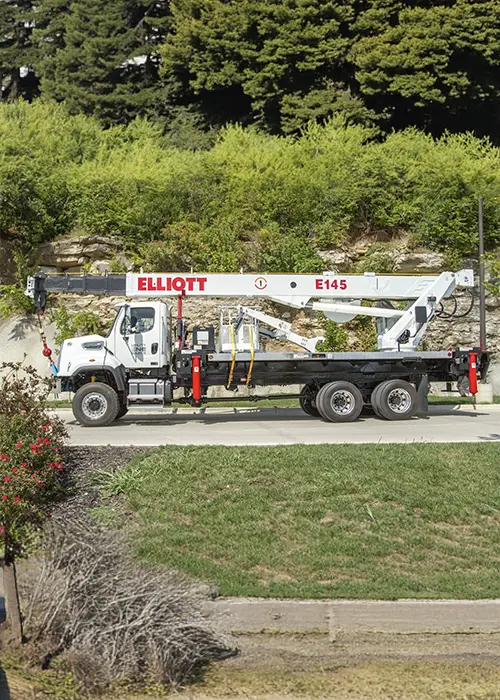
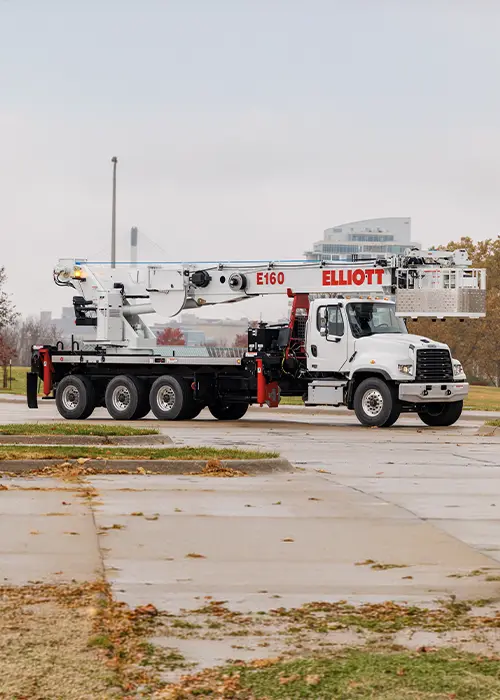
| E145 | E160 | E190 | |
 |
 |
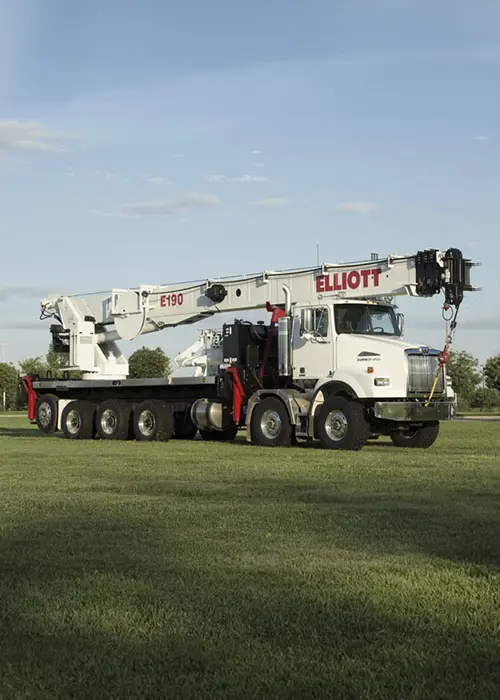 |
|
| Working Height | 145 ft | Up to 215 ft w/jib | Up to 238 ft w/jib |
| Side Reach | 80 ft | 90 ft | 90 ft |
| Platform Capacity | 1,200 lb | 1,200 lb | 1,200 lb |
| Main Winch | 18,000 lb | 20,000 lb | 30,000 lb |
| Model Highlight | Versatile reach | Extended reach | Maximum reach + power |
One important distinction sets the E-Line apart: these are not cranes adapted for aerial work. They’re purpose-built aerial work platforms designed and tested to meet or exceed ANSI A92.2 requirements in every operating mode — including both personnel lifting and material handling. That means crews are always using the right, compliant tool for the job.
One Machine. Two Critical Jobs.
The biggest advantage of the E-Line isn’t simply how high it reaches — it’s everything crews no longer need to bring to the jobsite.
With one machine, crews can position personnel for stringing, clipping, inspections and maintenance, then immediately transition to lifting the materials needed to complete the work.
That capability comes from features built directly into the platform, including:
- Heavy-duty main winches with capacities up to 30,000 pounds on the E190 for lifting transformers, insulators and crossarms
- The 1,500-pound EZ-Stow Platform Jib Winch (available on the E145) for positioning smaller tools and components directly from the basket
- Tool circuits and material-handling accessories that help crews manage conductor, hardware and other critical materials without requiring a second machine
Eliminating one truck from every setup doesn’t just save time on a single job — it creates efficiencies that compound across projects measured in miles.
Faster Setup Where It Matters Most
Transmission work rarely happens on level pavement.
Crews routinely work across uneven terrain where setup and teardown consume valuable production time.
That’s why every E-Line comes standard with EZ-Crib outriggers, reducing setup and takedown time while improving stability on difficult ground. Combined with Elliott’s point-and-shoot telescopic boom, full-length subframes and oversized rotation bearings, operators can position the machine quickly while maintaining confidence under load.
The result isn’t simply greater productivity — it’s a more stable work platform in the environments where stability matters most.
Precision for Energized Line Work
When working near energized conductors, precision isn’t a convenience — it’s essential.
The E-Line features DynaSmooth proportional controls, delivering smooth, predictable boom movement for precise positioning during energized line work. Dual-function platform controls can be operated directly from the basket or detached for full-function radio remote operation, while optional wireless remotes provide even greater flexibility depending on the application.
The more precisely the machine responds, the more confidently crews can work in tight, demanding environments.
It Was Built with Crews, Not Just for Them
The E-Line wasn’t developed in a conference room.
It originated through a collaboration between Elliott engineers and MYR Group, a leading national electrical contractor, to solve a real-world challenge: combining personnel access and heavy material handling into a single machine for transmission work.
That origin is one of the reasons the E-Line feels like it was designed by people who do the work — because, in part, it was. By working directly with contractors in the field, Elliott engineered a platform that reflects real jobsite challenges rather than theoretical ones.
Built for Today’s Utility Challenges
Utilities are being asked to accomplish more with leaner crews, tighter schedules and uncompromising safety expectations.
Whether crews are building new transmission infrastructure, performing routine maintenance or responding to storm restoration efforts, reducing equipment on the jobsite can improve efficiency while helping crews stay focused on the work at hand. Every decision — from equipment selection to crew deployment — affects productivity, logistics and overall project efficiency.
The E-Line answers that challenge with one purpose-built, ANSI A92.2-compliant transmission line aerial work platform that combines personnel lifting and heavy material handling in a single machine.
Fewer trucks. Fewer setups. Less congestion. Greater flexibility. More work completed.
Sometimes innovation isn’t about adding another machine. It’s about making one machine capable of doing more.
See What Fits Your Work
Explore the full E-Line lineup to compare models and specifications, or talk with an Elliott representative about configuring the right solution for your application.
Frequently Asked Questions
What is the Elliott E-Line?
The E-Line is Elliott’s family of purpose-built transmission line aerial work platforms engineered for utility and electrical construction applications. Designed to combine personnel lifting and heavy material handling in a single machine, each model is built to meet or exceed ANSI A92.2 requirements in every operating mode.
How high does the E-Line reach?
The E-Line offers working heights of up to 240 feet, with models ranging from the E145 – E190. This allows crews to match the appropriate working height and side reach to the specific application.
Can one aerial lift handle both personnel and materials?
Yes. The E-Line is designed as a dual-purpose aerial work platform featuring heavy-duty main winches with capacities up to 30,000 pounds on the E190, along with a 1,500-pound EZ-Stow Platform Jib Winch on select models. This allows the same machine to position personnel and lift heavy materials, eliminating the need for a second piece of equipment.